The quiz asks you about frame data and marks the answer. It is the half of Tekken the input trainer cannot help with: knowing a move is -13 does not change what your hands do, so there is no motion to rehearse, only something to recall under pressure.
Questions are built from the fact corpus, never written by hand. Every one shows where its answer came from, and anything you get wrong comes back sooner than the things you already know.
Where the questions come from
Two sources, and the difference between them decides what you get asked.
The smaller one is a few moves per character, distilled by hand from published frame tables and carrying more than the numbers: notes, resolved contradictions, and the pushback figure that makes a punish question possible at all.
The larger one is the same frame data the character pages are built from, which covers the whole roster. Most of what the quiz asks now comes from there, and the deck is thousands of questions rather than hundreds.
The larger source has to be quieter about some things, and the quiz respects that rather than filling the gaps in:
- No punish questions. Whether a blocked move leaves you close enough to punish is not in any frame table, and a punish that whiffs is worse than no question. Those come only from the hand-checked half.
- Ranges that cross zero are skipped. A move published as anything from slightly minus to slightly plus has no single honest number to ask for.
- A string is asked about what you blocked, not what it opened with. Frame
data records a continuation's own hit level, so
1,1carries the level of the second hit. The quiz will ask what that string is on block, which is a fact about blocking the whole thing, and will not ask what it hits as.
The two filters
matchup picks whose moves you are asked about. you play picks who has to land the punish. They are independent, and either can stay on "All characters" / "Any character". Your own characters float to the top of both lists, most-played first, so you are not hunting through the whole roster for the two names that matter to you.
Both are seeded from the address bar. /quiz?matchup=Dragunov opens on
Dragunov's moves; /quiz?you=Jin opens with Jin landing the punishes. That is
how the practice links on a matchup page, a priority row and a
character page get you here with the context you were reading about already
applied. A name the corpus does not carry falls back to the unfiltered deck,
because a select displaying a value that is not one of its own options, above a
deck with nothing in it, is a dead end you cannot get out of without editing the
URL.
Include unverified claims is off. Turn it on and the deck grows, every added
question carries an unverified badge, and both dropdowns gain whichever
characters only had unverified facts.
The two counter lines
The first line is this sitting: how many you answered, how many you got right, the percentage, and your current and best streak. It resets when the page does.
The second line describes the deck itself, and it is the one worth reading:
- in scope — questions the current filters can produce at all.
- new — in scope and never answered.
- due — answered before and ready to be asked again now.
- scheduled — answered and not due yet. These are the ones you know.
- missed before — questions you have got wrong at least once. A high number here is a reading list, and the matchup pages are where to go with it.
Narrowing the matchup filter narrows all five. A character with thin frame data produces few questions, which is a property of the corpus and not a fault in the filter.
The question card
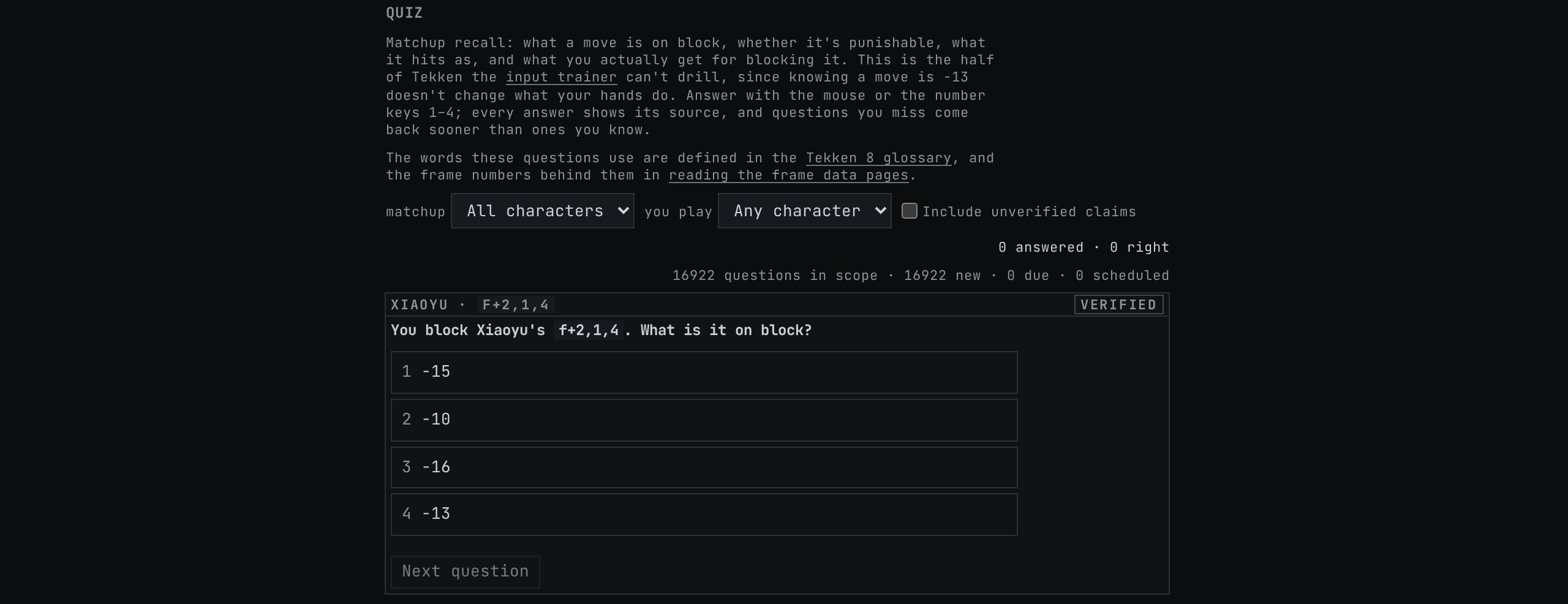
The header names the character and the move in your chosen notation, with a badge for how well-sourced the answer is. Then a prompt and four options.
Answer with the mouse, or with the number keys 1 to 4, which match the
numbers printed beside the options. The keys are ignored while a dropdown or a
text field has focus.
On reveal, the correct option is labelled correct in text and yours is
labelled your answer. Nothing depends on colour: the reveal reads identically
to a screen reader, in high contrast, and to anyone who cannot separate the
win and loss hues. Under the options comes a sentence marking the answer, then
the explanation, then the source link. A miss also gets a pointer to the
glossary, on the reasoning that being wrong is the moment a
word in the explanation is worth chasing, and being handed the same link on
every right answer is noise.
Focus moves to Next question when you answer, so the reveal is announced and Enter carries you on. Next moves focus back to the prompt.
What it asks
Five kinds of question, each gated on the facts that make it knowable. A move with no on-block value never produces a frame question; a move whose pushback was never recorded never produces a punisher question. A thin corpus yields a smaller deck, and no guesses.
What is it on block? The wrong answers are drawn from other real moves'
block advantage and kept within eight frames of the truth, so the question is a
judgement call. Offering +40 against a -13 would answer itself.
Is it punishable? Four bands, disjoint, so this is a real four-way question and getting it wrong tells you something:
| Band | Range |
|---|---|
| Launch punishable | -15 or worse |
| Non-launch punishable | -10 to -14 |
| Safe | 0 to -9 |
| Safe, plus | +1 or more |
Zero sits in the safe band. Nothing is given back at 0 and nothing is gained; the next move decides it, and grouping zero with the plus frames would promise a turn the frames do not. The band labels lead with the category because the category is what you carry into a match. An earlier set led with "Yes" and "No", which put your eye on the yes/no and left the two yeses to be told apart by the tail of the sentence.
What does it hit as? High, mid, low, or special mid. On a multi-hit move the prompt asks specifically about the first hit, and the explanation spells out the whole sequence.
Can you duck it? Gated hard on two facts agreeing with each other. A move flagged duckable that is not a high, or a move flagged not-duckable with no blockable level, is a contradiction in the data, and the generator drops it instead of teaching you a guess.
What's your best punish? The strictest question here, and the one with the most refusals built into it.
How the punisher question protects itself
Frame data alone cannot tell you whether a punish reaches. A -13 that shoves you out to sweep range is a different problem from a -13 in your face, and answering from the frame number alone teaches a whiffed punish in a real match. See using the frame data for the long version.
So the question only exists when the move's pushback is actually recorded. When there is pushback, the correct answer has to be a punish flagged as one that still reaches; everything fast enough on frames but not flagged becomes a wrong answer, because that is precisely the mistake this question exists to correct.
Two more filters run before the options are built. Only punishes you can execute from the stance the block left you in are eligible, as the answer or as a distractor, so a while-standing answer never appears against a blocked mid. And the question asks for the best punish, not merely one that connects: at -13 an i10 jab connects too, which would leave several right answers and no usable wrong ones. With no damage figures in the fact contract, the standard Tekken ordering stands in, so the slowest punish that still fits the window is the biggest one you get. The explanation states that rule out loud. If two punishes tie for slowest, the question is dropped; marking an equally good answer wrong would be teaching you something false.
How well-sourced the answer is
Four levels, badged on the question and repeated on the reveal: verified, community-sourced, inferred, unverified. A question is only as trustworthy as its weakest input, so a verified frame number combined with a community-sourced punish makes a community-sourced question, and the badge says so. Anything below verified says plainly that it should not be taken as gospel, and every answer carries a link to where it came from.
When it says "Nothing to ask"
No question can be built from the facts currently in scope. It is almost always the matchup filter: widen it, or clear it. A character whose frame data is thin in the corpus genuinely has fewer askable questions, and the page says so instead of assembling something out of the gaps.
What the scheduler does
Each question carries a card, and answering folds one result into it. The rules are small on purpose:
- Get it right and the interval grows. One day, then three, then multiplied by the card's ease each time, capped at a year. The ease drifts up by 0.1 per hit, to a ceiling of 3.
- Get it wrong and the interval collapses. The card comes back in ten minutes,
inside the same sitting; its ease drops by 0.2, with a floor of 1.3; and its
lapse count goes up, which is what surfaces it in the
missed beforetally instead of letting it cycle quietly forever.
New cards start at an ease of 2.5 and are due immediately.
What gets asked next follows one order: whatever is genuinely due, most overdue first and the more-missed card breaking a tie; then one you have never seen; then, so a session does not dead-end on "come back tomorrow", whichever card is due soonest. Cards for questions outside the current deck are ignored and not deleted, so changing the matchup filter for an evening costs you nothing.
Question identifiers are derived from the facts alone, so they survive a reshuffle of the deck and a reload. Option order is reshuffled on every visit, and the right answer will not sit in the same slot twice by habit.
What is stored
The schedule lives in your browser alongside your match history, and a backup carries it. Restore on another machine and the questions you had learned are still learned, with the ones you keep missing still due. What else a backup holds is in where your data lives.