This is the by-player view. Matchups and Priority cut the same imported history by character, and the strip under the heading moves between the three. Here a row is a person, and every game you have played against them is added up regardless of who either of you picked.
A one-line definition sits under the strip, and net rating is the number in it: points taken from them, or lost to them.
The rivals line
Anyone you have faced five or more times counts as a rival, and the line above the pool names how many you have, your worst record among them, and your best. Both names link through to that person's page.
Five is a definition and not an evidence floor. Nothing gated on it is an estimate, which is why it is a fixed number with no entry in Settings. This page and the dashboard's records board have to mean the same thing by the word, and somebody changing their sample floor is not asking for a different cast of characters.
Opponent pool
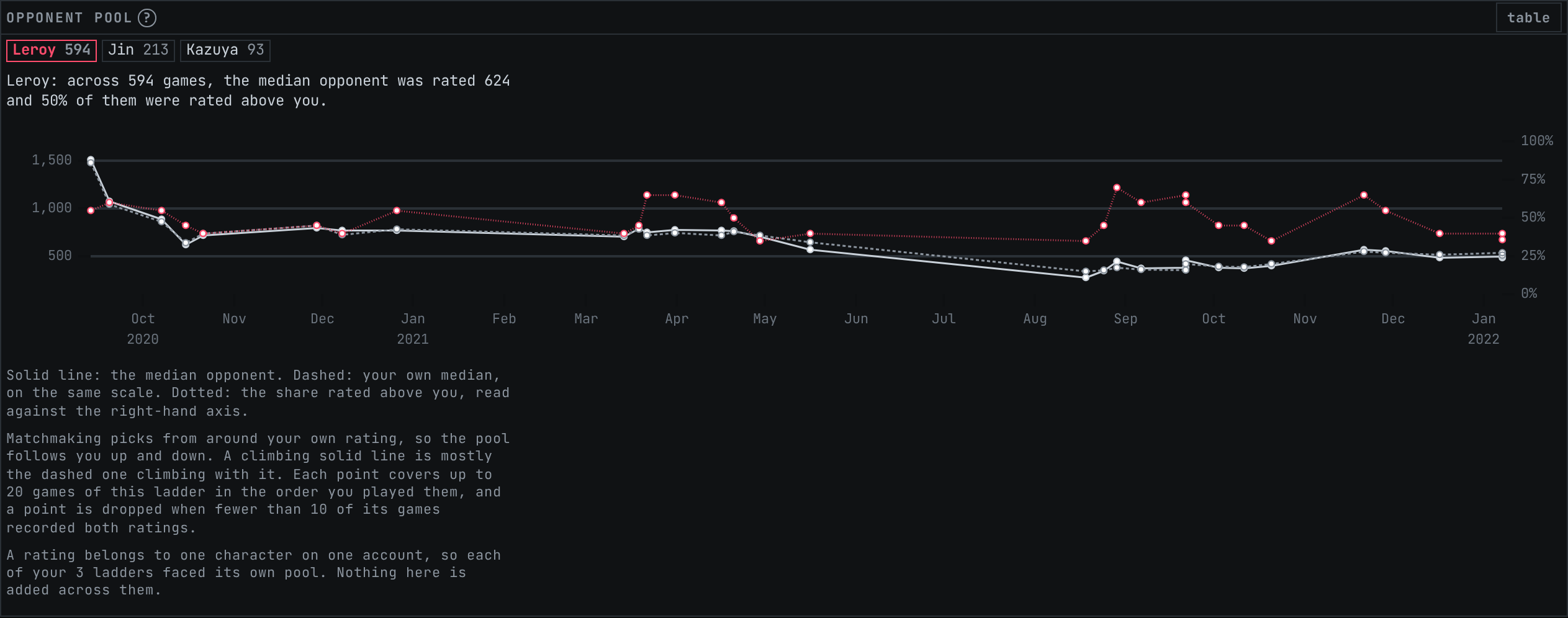
The panel under the rivals line asks who matchmaking has been putting in front of you. It is the most misreadable reading on the site and it is built to fight that.
A rising opponent median looks like a compliment and is mostly a mirror. Matchmaking draws from around your own rating, so when you climb the pool climbs with you, and a chart of the pool alone is a chart of you with the label filed off.
Three lines, on two axes:
- Solid: the median rating of the opponents you faced.
- Dashed: your own median over the same games, on the same scale.
- Dotted: the share of those opponents who were rated above you, read against the right-hand axis.
The dashed line is there so the solid one cannot tell the flattering half of the story on its own. When the two climb together there is nothing to explain. The dotted line is the one that survives the objection, because it only moves when the pool moves relative to you. Against a matchmaker that tracks you perfectly it sits near half forever, whatever either median does.
No verdict is produced anywhere in this panel. There is no threshold, no title, and no sentence that calls a number good or bad.
Per ladder, always
A rating belongs to an account and a character together, so each of those pairs is a separate ladder with a separate pool, and the chips above the chart switch between them. Nothing is ever added across them.
That is not a technicality. On one real history the Leroy ladder faced opponents rated above the player 39% of the time and the Armor King ladder 74%, while a merged series over both read 43%, a number describing neither. The merged median also moved: it opened at 1836, fell to 1654, and climbed back, which looks like a story about who that player was meeting and is nothing but the week they switched character.
When you have more than one ladder the panel says so under the chart.
The blocks, and what a gap in the line means
Each point covers a block of consecutive games in the order you played them, sized by the Sparkline window setting. Blocks partition the ladder: every game is in exactly one, the counts add back to the ladder's total, and a point is a stretch of play you can go and find in the match log.
A trailing rolling window was the alternative and it lies about resolution. It emits a point per game, each sharing all but one game with its neighbour, so twenty easy opponents in a row show up as twenty points of drift that are one event.
A block publishes nothing when fewer than Minimum sample size of its games recorded both ratings. All three figures go at once, the line breaks there, and the table view prints dashes. They rest on the same sample, so the floor is decided once for the whole block. A median of three games swings further on a rating axis than anything real the chart is there to show.
The same floor applies to the sentence above the chart, which summarises the whole ladder as one block. Under the floor it tells you how many of the ladder's games carried both ratings and how many the floor wants, and holds the figures back.
Every figure is read off the ratings the two of you carried going into each game. No rating change is summed here at any point, which matters because the change wavu displays is floored and does not add back to the rating; the Matchups guide sets out that correction in full. Draws count, unlike every win rate on the site, since the question is who you were put in front of and a drawn game was still a game against somebody.
The panel header has a table toggle for the same numbers as rows.
Opponents faced
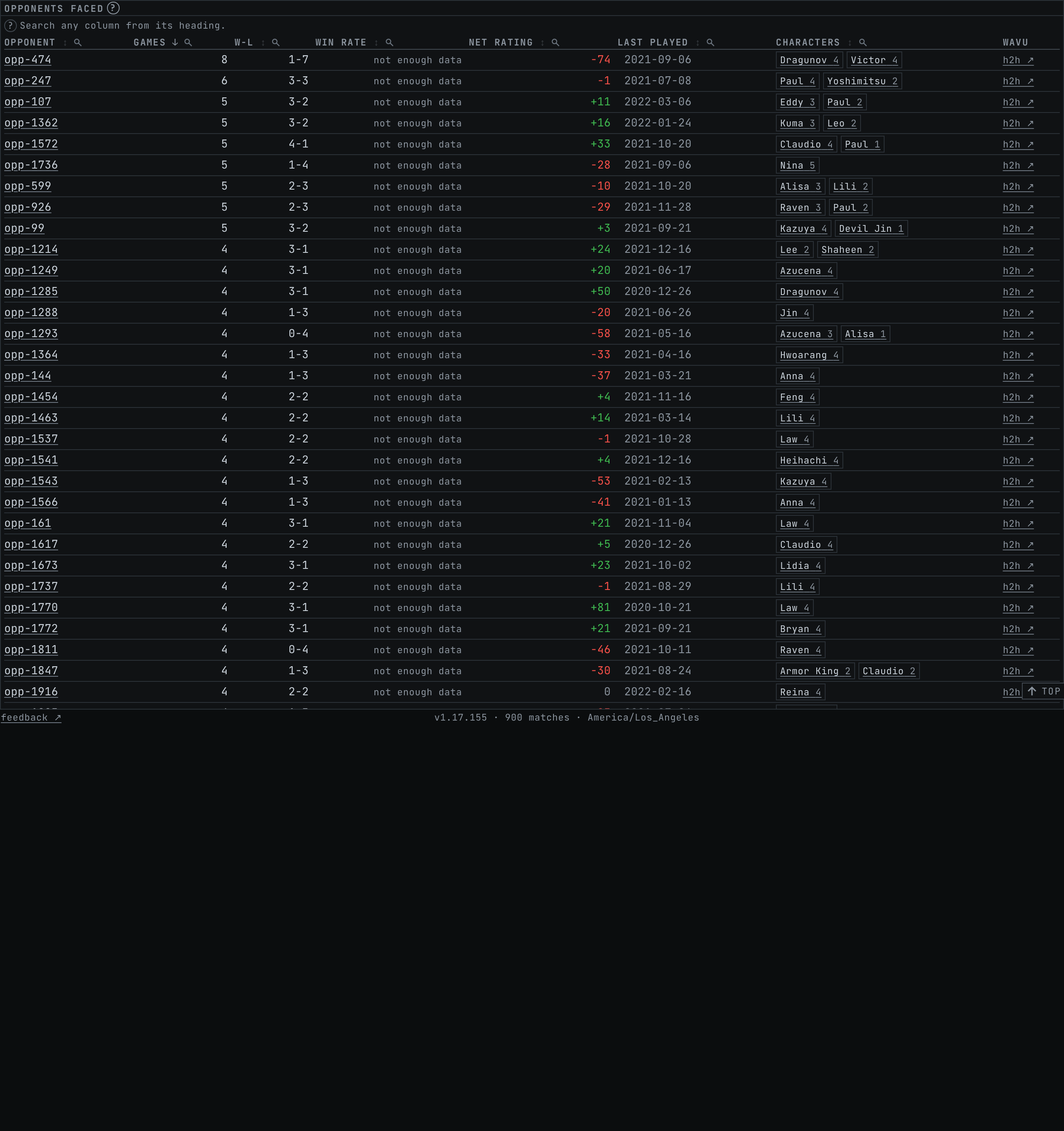
One row per person, most-played first, fifty to a page.
| Column | What it holds |
|---|---|
| Opponent | Their name, linking to their own page. |
| Games | Every game against them, draws included. |
| W-L | The record. |
| Win rate | Wins over decided games. |
| Net rating | What those games actually paid or cost you. |
| Last played | The date of your most recent game against them. |
| Characters | Every character they used, with a game count, linking to frames. |
| Wavu | An outbound head-to-head link on wavu. |
The name shown is the most recent non-empty one the export carried, since wavu reports current names and people rename themselves. Where no name was ever captured the Polaris ID stands in.
Both the name column and the character chips are searchable from the magnifier in their headings, and the character search covers the counts as well as the names, so the text you can see is the text that matches.
A row can span more than one of your own accounts when the active profile unions several. The head-to-head link needs a single "you", and there isn't one for an aggregate, so it uses the account from your most recent game against that person.
A person under your sample floor reads not enough data where the percentage
would be, the same as everywhere else on the site. The games column stays, so
you can see how far off it is.
This table carries no confidence interval, which is the one thing it still does differently. That is a missing column rather than a disagreement: the rate it prints has cleared the same floor the rest of the site uses. The Matchups guide has the full rule.
One person's page
Clicking a name opens everything stored about that head-to-head.
Under the heading sits their Polaris ID and, when the ratings are there, a line placing you against them: rated higher, rated lower, or evenly matched, with the average gap. The threshold either way is a hundred points, and the average is fair here because two players' ratings tend to drift together across a history, so one number describes the whole thing.
Four tiles: the record, the win rate with its interval, the net rating with the sign coloured, and when you last played.
Their characters is one bar per character they have used against you,
most-played first, each with its own record. A character you have only met a
couple of times reads not enough data instead of a percentage, on the same
floor as everywhere else. A person is not a matchup. The
same opponent can be three different problems, and a single win rate across all
of them hides which one is actually beating you.
Rating swing is the running total of what this one person has taken from you or paid you. A rival you are level with on matches can sit well negative here when the games you lose to them are worth more than the games you win. The table view lists the last thirty points.
The runback splits your record against them into game one of each rematch set and everything after it. A set is two or more consecutive games against the same person, and a different opponent appearing in between ends it, so the split is computed over your whole timeline and not only over the games in this page's filter. Sets of one game have no runback and are ignored.
Win game one and lose the runbacks and they are adapting to you faster than you are adapting to them. The reverse means you download people as a set goes on. Holding the opponent fixed like this makes it the cleanest before-and-after on the site, with one honest alternative reading: losing the first game is also evidence they are simply better.
Match log is every match against them, newest first, fifty to a page, exactly as imported with nothing derived. Draws, unrated matches and gaps in the history are all visible here even where the averages above absorb them. Every number further up the page is computed from these rows.
Opponent notes
Each person's page carries a notes field, and this is where scouting goes. "Mashes out of throws." "Always steps left after a blocked launcher."
It saves when focus leaves the box and confirms with a Saved ✓. Notes are
keyed to that specific player, so the next time you run into them the note is
already open. They stay in this browser, they travel in backups taken from the
Data page, and a share link never carries them.